


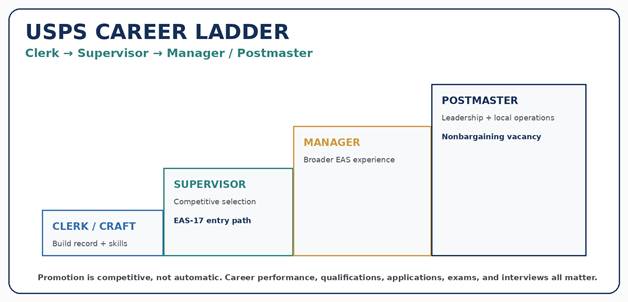
USPS Promotion Is a Career Path, Not an Automatic Ladder
A postal employee can move from clerk or another craft position into supervision and eventually compete for postmaster or other management jobs, but there is no automatic promotion sequence. USPS fills many higher-level jobs through formal in-service application, assessment, qualification, interview, and selection procedures.
The best way to think about advancement is to build evidence that you can handle more responsibility. Strong attendance, operational knowledge, customer service, safety, problem solving, communication, and leadership experience all become more important as you move from bargaining-unit work into nonbargaining EAS positions.
Stage 1: Build a Strong Craft Record
Clerks, carriers, mail handlers, maintenance employees, and other craft workers learn how the postal network operates from the ground level. For a clerk who wants to move up, the first goal should be mastering the current job rather than app for management immediately.
- Maintain reliable attendance and a strong safety record.
- Learn the operational reasons behind procedures, not only the steps.
- Volunteer for training and developmental assignments when appropriate.
- Build experience handling customer problems and workflow exceptions.
- Learn how staffing, dispatch, service performance, and productivity connect.
Applicants starting in roles such as Mail Processing Clerk can use processing experience to build an understanding of mail flow, equipment, service standards, and team operations before competing for leadership roles.
Stage 2: Prepare for an Initial Supervisor Position
USPS has a formal Supervisor Selection Process for two initial-level supervisory positions: Supervisor, Distribution Operations, EAS-17, and Supervisor, Customer Services, EAS-17. These are common entry points into nonbargaining management for career postal employees.
When a position is filled competitively, eligible employees apply during the vacancy period. The current April 2026 Handbook EL-312 says competitive applicants may have to complete applicable examinations, application review, and an interview. The goal is to identify candidates who meet the qualification requirements and demonstrate supervisory potential.
What Makes a Strong Supervisor Candidate?
|
Skill Area |
Craft-Level Evidence |
Supervisor-Level Value |
|
Operations |
Understands mail flow and procedures |
Can organize work and solve bottlenecks |
|
People skills |
Works well with coworkers and customers |
Can coach, communicate, and handle conflict |
|
Reliability |
Strong attendance and safe work habits |
Can be trusted with staffing and accountability |
|
Judgment |
Handles exceptions correctly |
Can make decisions under pressure |
|
Performance |
Meets quality and productivity expectations |
Can manage service and performance metrics |
Stage 3: Learn the EAS Management Side
After moving into supervision, advancement becomes broader. USPS nonbargaining positions include supervisory, managerial, administrative, technical, and postmaster roles under the Executive and Administrative Schedule and other management pay systems.
A supervisor who wants to become a postmaster benefits from experience in customer service, staffing, labor relations, budgets, safety, service performance, employee development, and local operations. Distribution experience can also be valuable, but postmaster work places heavy emphasis on managing an installation and serving a local community.
Stage 4: Compete for Postmaster Vacancies
Most postmaster positions are filled under USPS nonbargaining selection rules. Career employees may apply when they are within the vacancy’s area of consideration and meet the listed requirements. Depending on the vacancy, the area of consideration may be local, expanded geographically, or broadened to additional eligible employee groups.
This means becoming a supervisor does not automatically make someone a postmaster. The employee still needs to qualify for the vacancy, submit a competitive application, and demonstrate that their experience fits the specific installation.
Employees and external job seekers can monitor broader Postal Service Jobs to understand the range of postal occupations, while current employees should also follow the internal applicant-tracking process for eligible advancement opportunities.
Career Development Matters Before the Vacancy Opens
USPS says career development is offered throughout the employee lifecycle, including functional training, technical hands-on learning, new-supervisor training, and management-to-executive development. The smartest time to prepare for promotion is before the job is posted.
- Complete relevant training and keep records of developmental assignments.
- Ask for feedback from current supervisors and managers.
- Learn to describe accomplishments with measurable results.
- Understand the requirements for the specific supervisory or management job.
- Develop experience across more than one part of the operation when possible.
How to Write a Strong Promotion Application
Higher-level USPS applications are qualification-driven. Do not simply list duties. Show situations where you improved service, handled a difficult customer, solved an operational problem, trained another employee, protected safety, managed competing priorities, or helped the unit meet a deadline.
For competitive selections, the application and interview should show not only that you understand postal work, but that you can lead people and make sound decisions.
Common Promotion Mistakes
- Assuming seniority alone guarantees a management promotion.
- App without addressing the vacancy’s qualification requirements.
- Using craft jargon without explaining leadership impact.
- Waiting until a postmaster vacancy appears before building supervisory experience.
- Ignoring customer service, communication, or employee-relations skills.
- Treating an acting assignment as a substitute for competitive selection.
Official Career-Development Reference
USPS describes its internal training and advancement approach on the official Career Development page, and the April 2026 Handbook EL-312 explains supervisor and nonbargaining selection procedures.
Frequently Asked Questions
Can a clerk become a USPS supervisor?
Yes. Eligible career employees can compete for initial-level supervisor positions when vacancies are posted and they meet the selection requirements.
What are the main entry-level supervisor jobs?
USPS identifies Supervisor, Distribution Operations and Supervisor, Customer Services, both EAS-17, as initial-level supervisory positions under the Supervisor Selection Process.
Do I need to be a supervisor before becoming a postmaster?
Not every path is identical, but supervisory and management experience is highly relevant because postmaster roles require leadership, staffing, service, and operational responsibility.
Does seniority guarantee promotion?
No. Many higher-level positions use qualification, assessment, application review, and competitive selection rather than simple seniority.
How should I prepare before a vacancy opens?
Build a strong performance record, complete development and training, gain leadership examples, and learn how to write accomplishments against position requirements.
Final Takeaway
Moving from clerk to supervisor to postmaster is possible, but it requires deliberate career development. Start by becoming excellent at the craft job, build leadership evidence, compete for an initial EAS supervisor position, and then broaden your experience in people management, customer service, operations, and performance. Postmaster selection is competitive, so the strongest candidates prepare long before the vacancy is posted.
